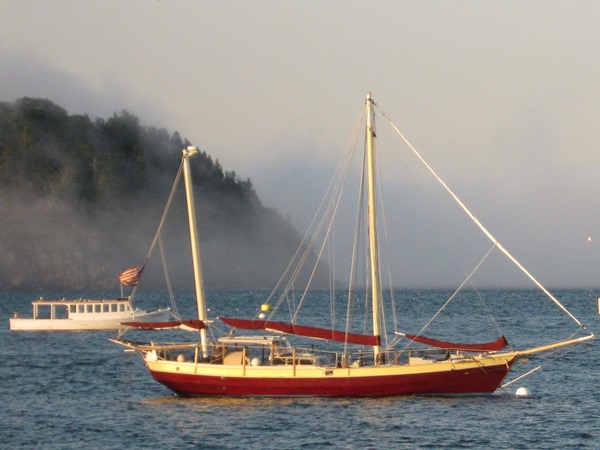
Tien Hou
History and Narrative
See Also
Tien Hou
Specifications
and Equipment Lists
INTRODUCTIONS
I
first saw
Tien Hou in the
Bahamas
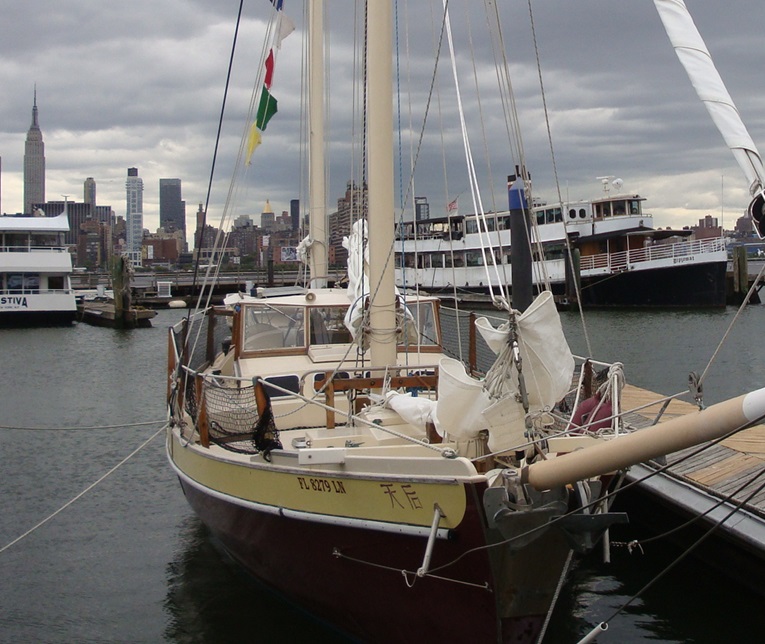
one morning in 2004 from the deck of my 32 ft cutter. I had
anchored off Staniel Cay as far inshore as I dared with my 5’ draft, since it
was a long row to town. Halfway between myself and the beach, I spied a gorgeous
ketch. I was gob smacked by her looks; I’d never seen such a striking vessel. My
next thought was “ How he’d get in so much shallower in a boat twice as long as
mine?”
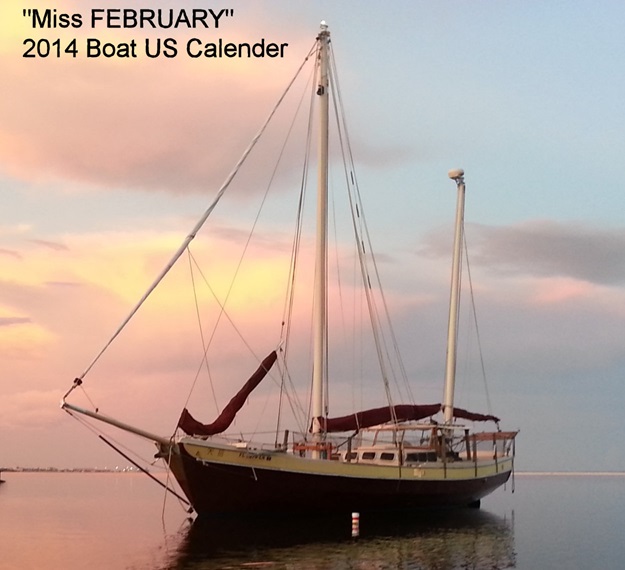
Later I saw a lone
figure rowing a dinghy out to her from the town. He scrambled aboard and in a
few minutes had the dinghy raised on davits and started hand cranking the anchor
up. As the morning breeze eased her downwind he went to the main mast and raised
an
impressive
gaff-rigged mainsail
and was soon sailing out past me. No noise, no fuss, no bother.
I turned to my crewmate and said “Now that’s a damn sailor, and that’s one hell
of a boat.” That was my first glimpse of Reule Parker, the owner, designer and
builder of Tien Hou (pronounced “t’yen ho”).
I next saw him in
2007 when clearing in at Fort Pierce. Fatefully, I ended up docked across the
slip from Tien Hou. She had a discrete “For Sale” sign on her. I immediately
called my crewmate at his home and begged,
“You’ve got to stop me! I’m going to buy a boat.” “You’ve got a boat,” he
replied. “I don’t care. I’ve got to get this boat.” And so, I did.
THE DESIGNER
Reuel Parker
is an internationally known designer and recognized
expert on cold molded wood construction.
He is the author of “The Voyages of Fisher Hornpipe,”
The Sharpie,” and “The New Cold Molded Boatbuilding,” plus 17 technical
articles. His catalogue of plans
includes 27 powerboats from a 13.5’ launch to a 60’ trawler and
69 sailboats, from an 8’ pram to a 70’ pilot schooner.
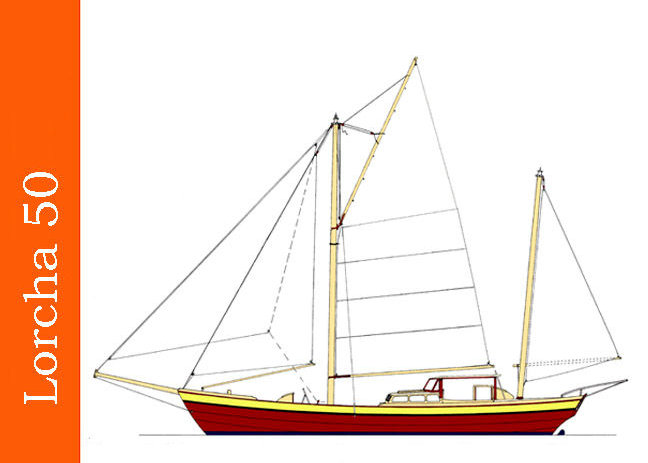
Reule designed and
built Tien Hou as his personal home. He was influenced by a historical vessel
called a
Lorcha
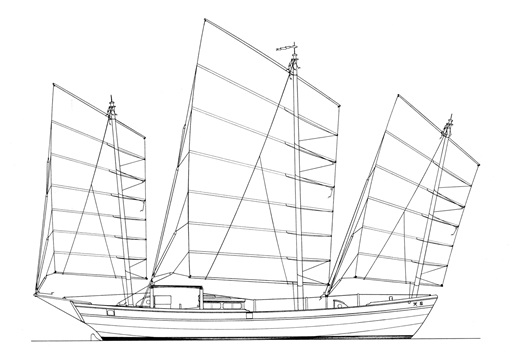
that evolved in the early 1600’s around Macao. It combined features of eastern
junks and western carvels. Like the originals, his Lorcha was initially
junk
rigged
with three free-standing masts. During sea trials he determined
the sails overpowered the hull, so he rerigged it to its current configuration.
Keeping the Asian theme, her named her after the
Chinese Goddess of
Heaven,
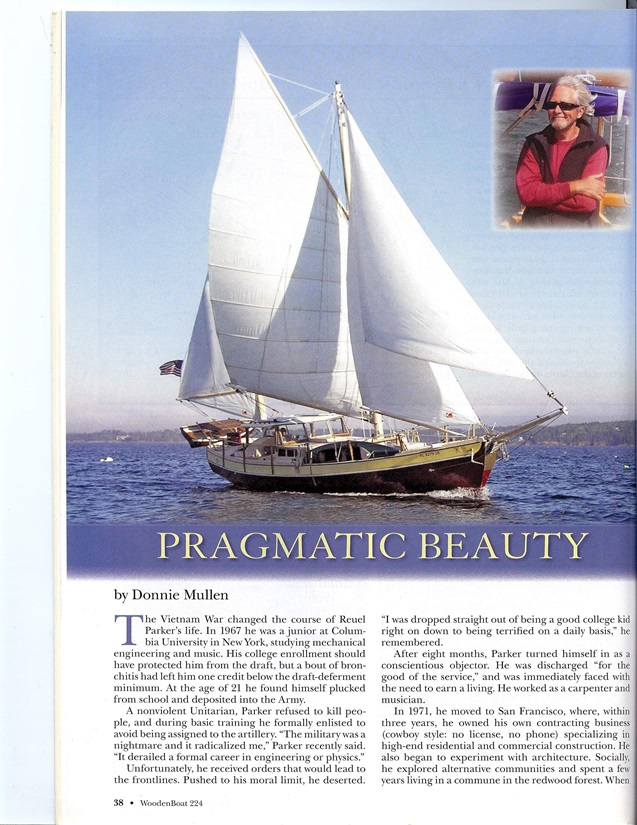
patron of sailors and mariners. Tien Hou has been featured in
Wooden Boat,
Professional Boatbuilder, Latitudes and Attitudes, and other
magazines.

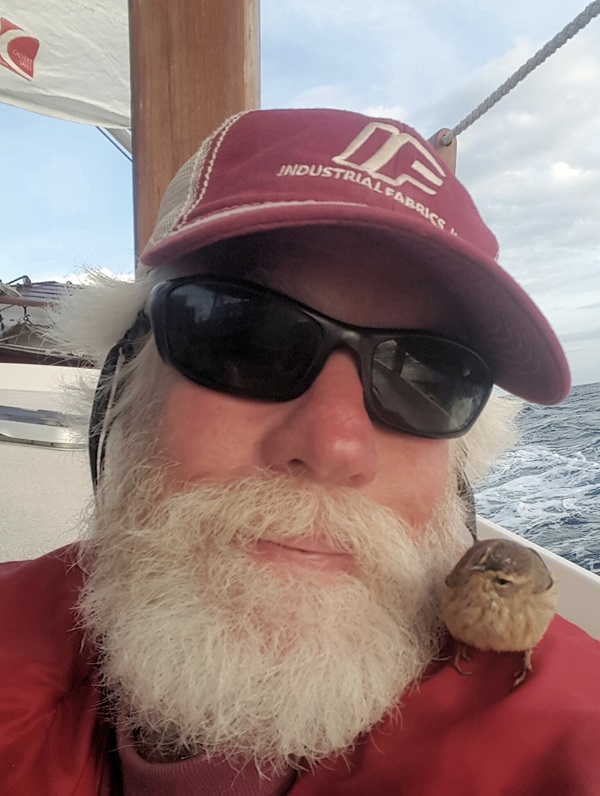
I’m a Florida native
who’s been sailing since I was a young boy. I have degrees in ocean engineering
and currently direct a consulting firm named
Emerald Ocean
Engineering.
I was a field engineer on land and underwater projects world-wide before getting
into academic and government research. Most of my later career focused on
coastal engineering. That penchant shows in my sailing preferences – I’m more of
a gunkholer than a blue-water sailor. I have taken Tien Hou from Florida to
Prince Edward Island, Canada, from
Manhattan
to Trinidad, mostly singlehanded.
Age
has made that more challenging and I’m not interested in having
a crew tote me around, so I am verry reluctantly putting “Tien Hou” on the
market.
I have enjoyed Tien
Hou as a floating test bed for my own designs at least as much as for voyaging.
I get satisfaction in implementing robust, effective solutions to typical
boating issues in maintenance and operation. Reule has designed a beautiful,
functional and unique vessel; I have endeavored to enhance his vision. Some are
highlighted below.
THE BOAT
The hull
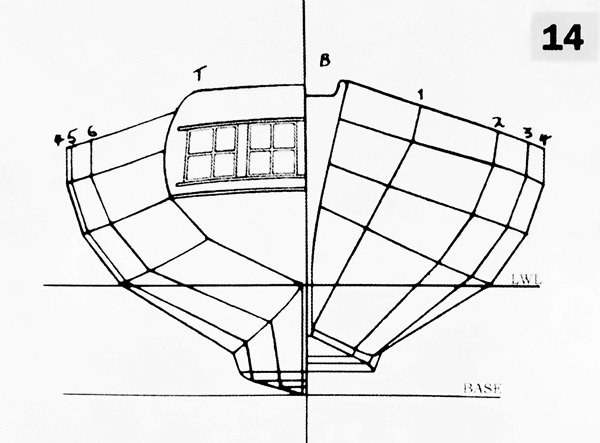
is based on a scaled-up version of the traditional multi-chined
Seabright Skiff, considered one of the most seaworthy small
craft. It is made from multiple layers of marine plywood fully sheathed in
epoxy-impregnated Xynole polyester cloth.
A box keel provides a sump for the engine, tankage, and internal ballast,
making for a low center of gravity. Foam-core sandwich decks and cabin tops
reduce weight above. The
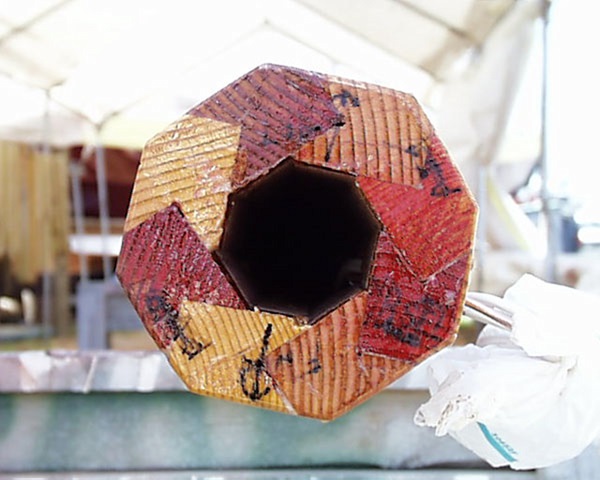
birds mouth hollow box spruce masts
were originally junk-rigged, so they are free standing. When it
was converted to a twin-headsail ketch, shrouds were added to the main mast to
provide counter-tension to the headsail stays. But the standing rigging is
redundant for its support. The mizzen remains unstayed.
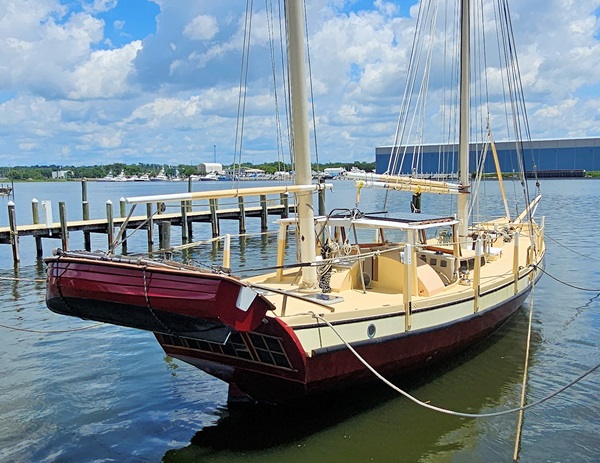
The boat is in
excellent condition. There are no leaks to the belowdecks; there is never any
mildew even after being laid up for months at a time. Every single item in the
inventory
functions like new. In addition, there are original manuals aboard for nearly
every item listed.
Boating takes work
I have spent a lot
of time on work boats of all kinds. When I describe Tien Hou as
more
workboat than yacht,
it’s a compliment. It borrows many features from working cargo
and fishing boats from the days of sail. This means things on board work and are
easily worked, systems are robust, access for
maintenance or repairs is a priority, and decorations that detract from
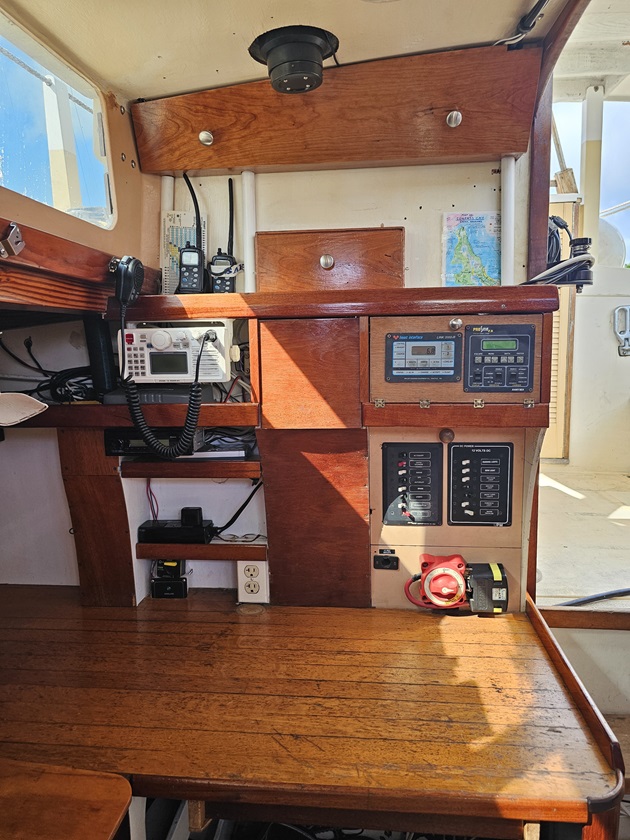
functionality are eschewed. Critical wiring and plumbing are left exposed or
readily accessible for monitoring and troubleshooting, not hidden behind vinyl
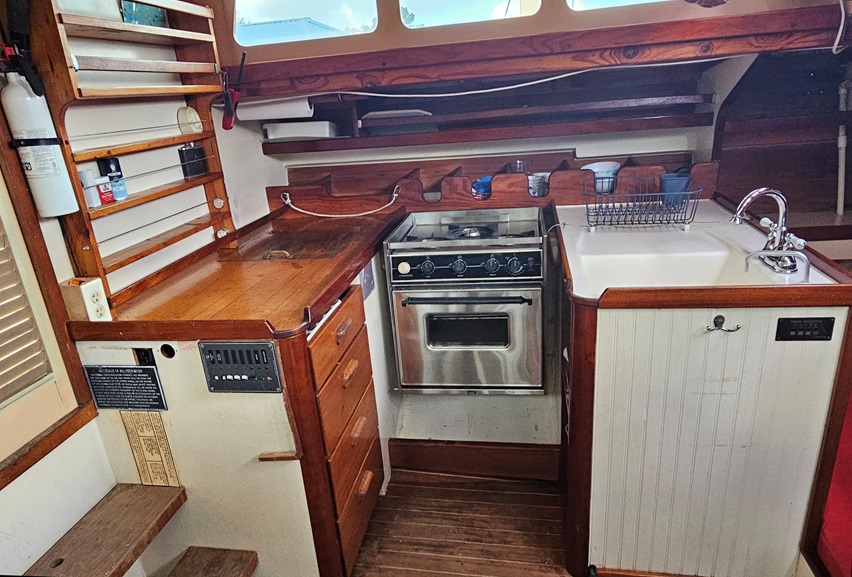
headliners. Belowdecks, away from the sun’s assault, there is a fair amount of
various
hardwood
and
cypress
trim, but a minimum of brightwork topsides. The nonskid on the
decks is the most effective I’ve experienced and is tough enough to lay out
lengths of chain on without concern.
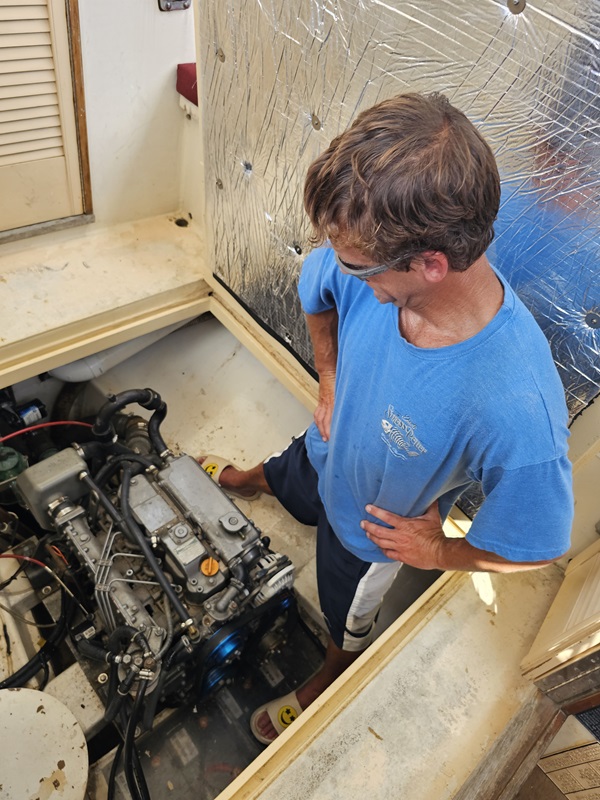
The 4’ x 4’ hatch in
the cockpit deck allows
full access to all
sides of the engine,
no contortions required. Bilge pumps, water level sensors,
sea cocks, strainers, oil and fuel filtration, belts, batteries, battery
charger, hot water heater and valving, throttle and transmission cables, even
the stuffing box are all visible, operable, adjustable, and repairable
while standing, sitting, or kneeling.
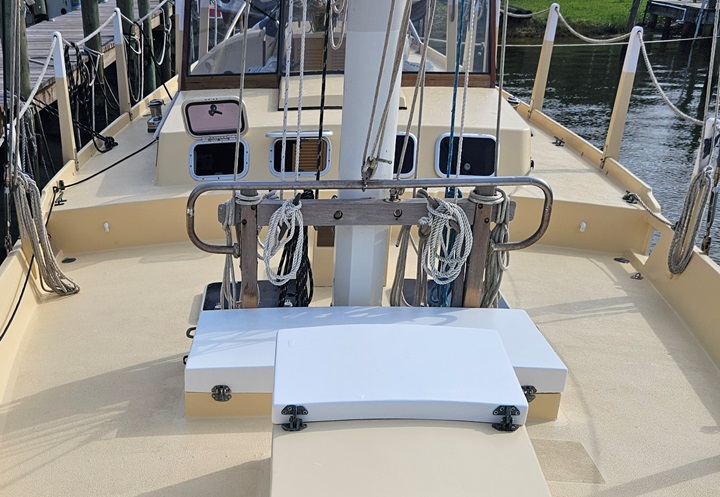
Another carryover
from working sail tradition is a
trestle tree at the
base of the mast.
Rather than crowding all halyards on mast-mounted cleats, the
tree provides ample room to separate and secure halyards and other lines handled
at the mast.
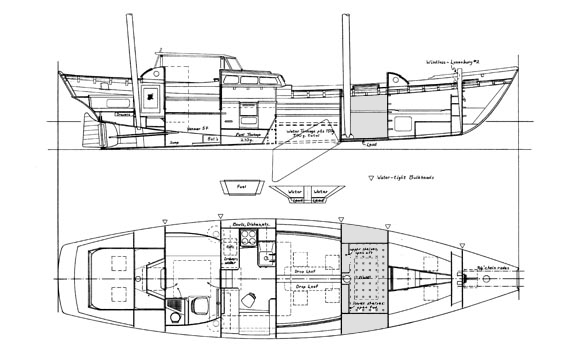
Just forward of the
mast is the workshop, or “cargo
hold,”
perhaps the most workmanlike aspect of the boat. It spans the
full beam in width and is 6’ in length. It contains the keel lifting gear, has a
workbench, two vices, an inverter for ac power tools, and shelves and bays for
storage. It’s an incredible asset to keep all tools, spares, smelly or dangerous
supplies (paints, lubricants, epoxy, etc.), the outboard motor, additional and
storm anchors, the drogue, fishing gear, etc., etc. in a separate compartment
instead of under a bunk or the floorboards in the living spaces. I would much
rather have that space than another stateroom for two more guests!
Unique feature 1 –
The Keel
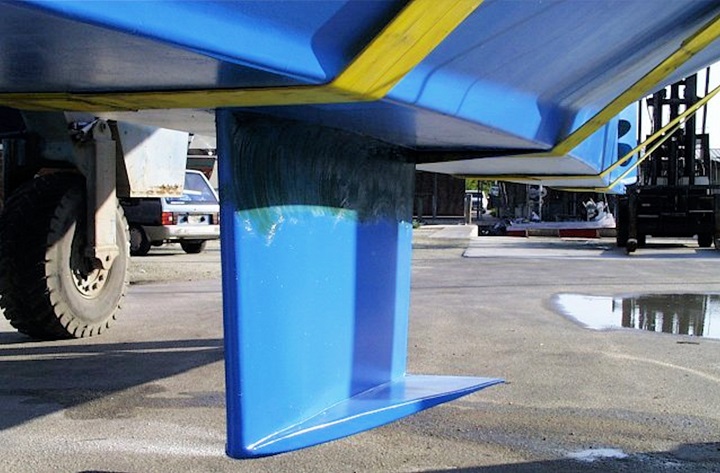
A 3’ draft is
unusual for 50’ monohull. This is
typically achieved with a tilting centerboard. The impact is tenderness and
reduced stability because of a higher center of gravity without a weighted keel
below the hull. That can be addressed with a lifting, ballasted keel. Tien Hou’s
NACA
foil shaped keel
adds 3500 lb of ballast that extends to a draft of 6’ 5”. This
provides the stiffness of a deep-keel hull and full righting ability in the
event of a knock down. At its base is a delta-shaped foil wing that improves
hydrodynamic effectiveness in reducing leeway. The wing tucks snugly under the
box-keel when the keel is raised, allowing the vessel to lay upright if dried
out on a level seabed; it can be careened for inspection or cleaning without
tilting.
Lifting ballasted
keel designs are rarer than light weight centerboards because they are more
expensive to build and challenging to engineer. The system I designed
for Tien Hou met that challenge and has functioned flawlessly for 17
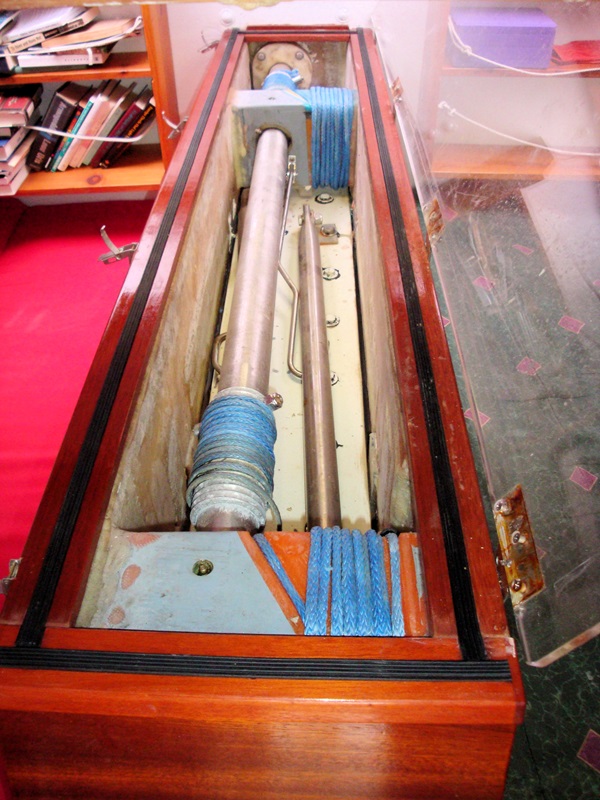
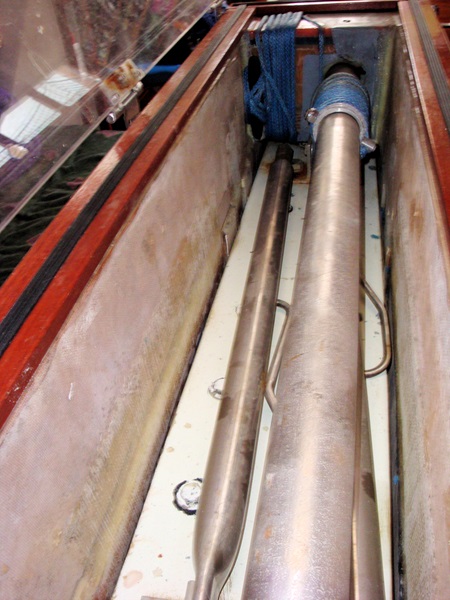
years. A hinged Lexan cover on
the keel trunk
allows immediate monitoring of the raising/raising process and
direct access to the lifting lines and bearings. The keel trunk’s laminated
walls support the two 4” x 8”
laminated beams
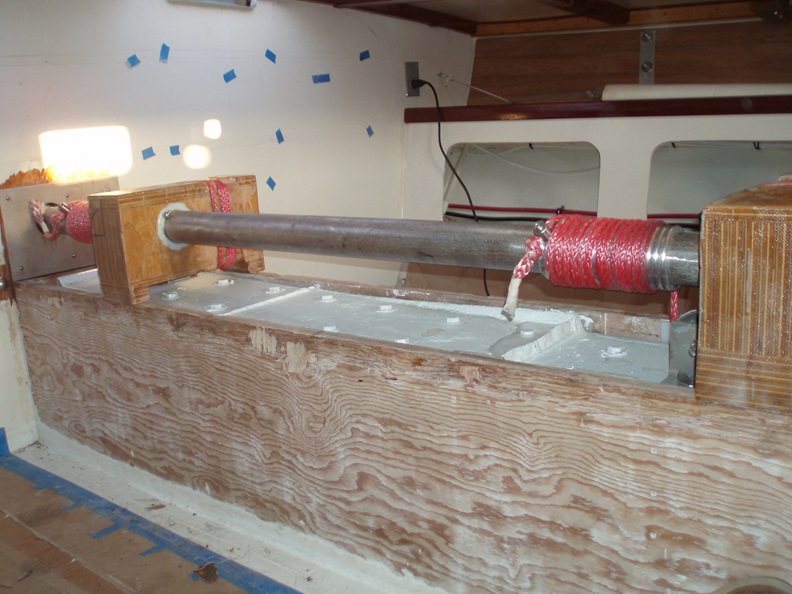
that support the keel. A rotating 2” schedule 80 ss pipe
riding on greased Delrin plain bearings does the heavy lifting. As the pipe
rotates, 3/8” Amsteel Dyneema lift lines (combined minimum tensile strength of
the over 48,000 lb) on custom-shaped aluminum level winds maintain correct
orientation from full up to full down positions. The forward end of the pipe
passes through the watertight bulkhead separating the main cabin from the cargo
hold on a third Delrin bearing.
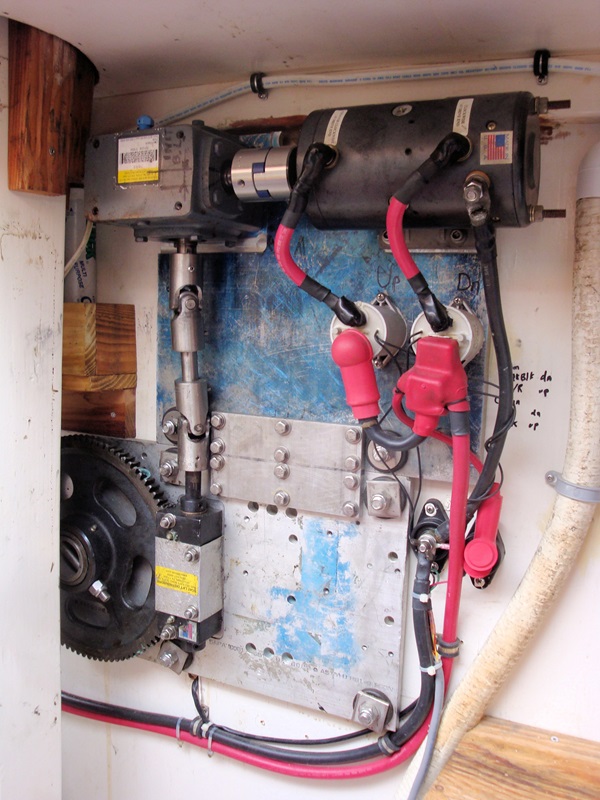
The drive
for the lift pipe is in the cargo hold. Power comes from a 1
hp DC motor and is transmitted through two reducers: an oil-bath, right-angle
drive reduction gear and a 12” bronze gear driven by a worm gear. Total lift or
lower time is about 45 seconds.
I change out the
lifting line every 5 years or so, though they have never shown signs of
significant wear. This is facilitated by four locking pins – machined ¾” diam.
ss bolts that screw into the trunk walls and support the keel underneath its top
flange. The top of this same flange holds two 1 ¾” sch 80 ss lock downs rods for
blue water crossings. These
fold horizontally
onto the flange
when not in use. After the keel is fully lowered, they can be
rotated to vertical and locked into place on the underside of the support beams.
This ensures the keel remains rigidly down in the unlikely event of a full
rollover. There are two control switches for the lifting gear – one at the helm,
for quick adjustment of the draft (“Shoal ahead!”) and one at the forward end of
the trunk for easy maintenance of the mechanism.
Anchoring
I’m an ardent
believer in reliable and versatile ground tackle. I carry five anchors, from a
45 lb spade to a 100 lb Danforth storm anchor. Anchor rodes are 350 ft of 1”
plaited Dacron and 200 ft of 3/8” galvanized chain. I trust the pair of 4’ long
oak 4x6
Samson posts
extending two feet below deck and secured to a watertight
bulkhead far more than any deck-fastened cleat. It is far safer and faster to
belay a running rode under a load around a vertical post at knee level than a
cleat at deck level. But the unique item is the windlass between the posts.
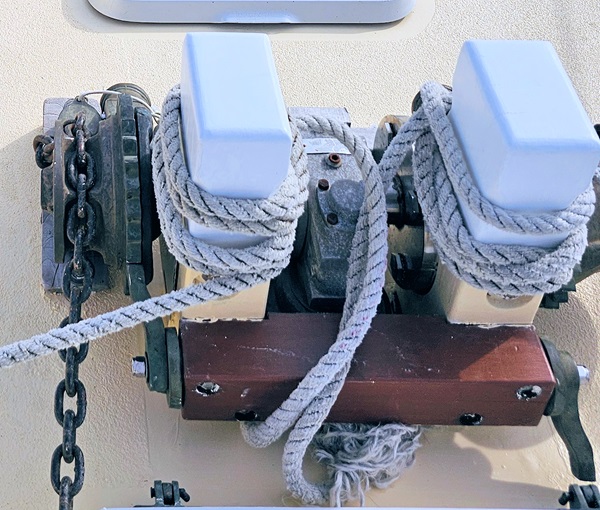
The original anchor
windlass was a massive, solid bronze manual-only
beast by
Lunenburg Foundry.
Two pick-axe-sized handles are inserted into ratcheting
sockets and allow dual, bicycle-like operation. I could deliver over a thousand
pounds of line pull while standing upright. It was slow but easy to use, very
powerful, and literally bulletproof. I used it for years – once to kedge myself
off a sand bar. But when single handing, it was a challenge (OK, comical) to get
underway in a crowded anchorage with even a light breeze or current - sprinting
between bow and helm to avoid collisions or entangling lines. I was unimpressed
by the available electric alternatives, especially their options for manual
backup. I definitely didn’t want to give up the Lunenberg’s
power and reliability. So, I
electrified the windlass
while maintaining its manual drive. I inserted a 60:1
reduction gear used in commercial crab boats between the rope gypsy and chain
wheel. The 1-hp reversing electric drive motor hangs vertically under the gear,
completely dry under the deck. It can pull in 90 ft/min of chain at 525 lb.
tension.
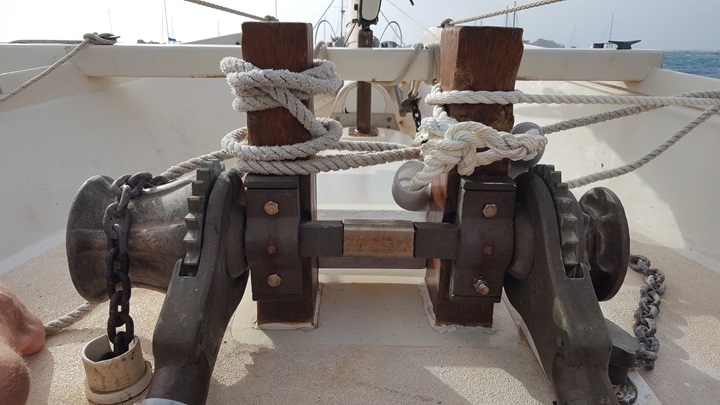
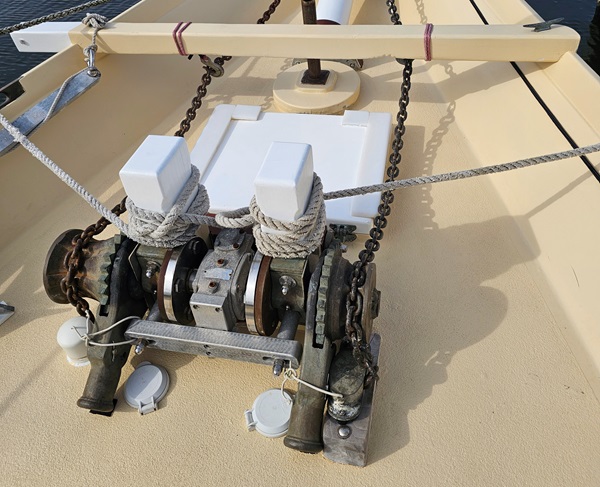
Since the reduction
gear cannot be back driven, it must be unlinked to use
the original manual drive. A pair of bronze and stainless flanges on each
side connect the gear to the driven heads. The flanges can be individually
engaged or disengaged by turning four ¾” ss bolts. There are two control
stations: one at the helm (no more fire drills), and foot switches at the base
of the winch.
Where’s the Dinette?
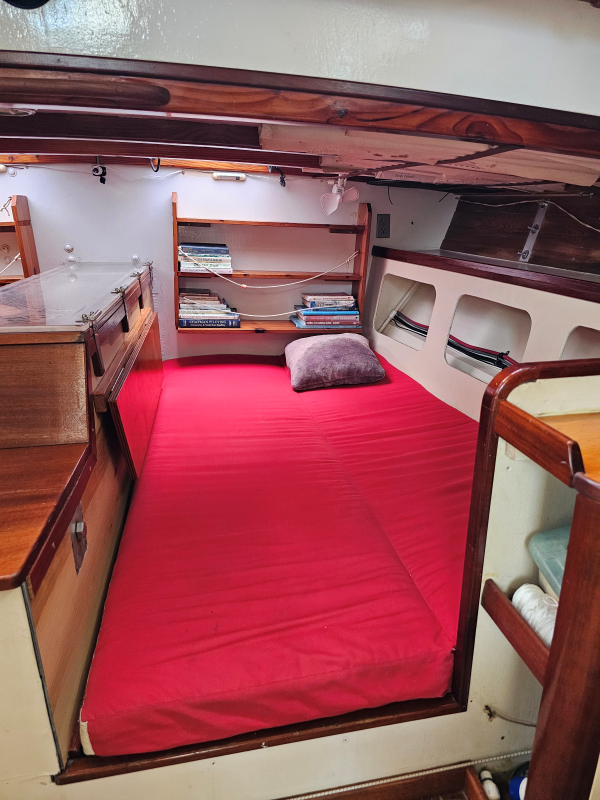
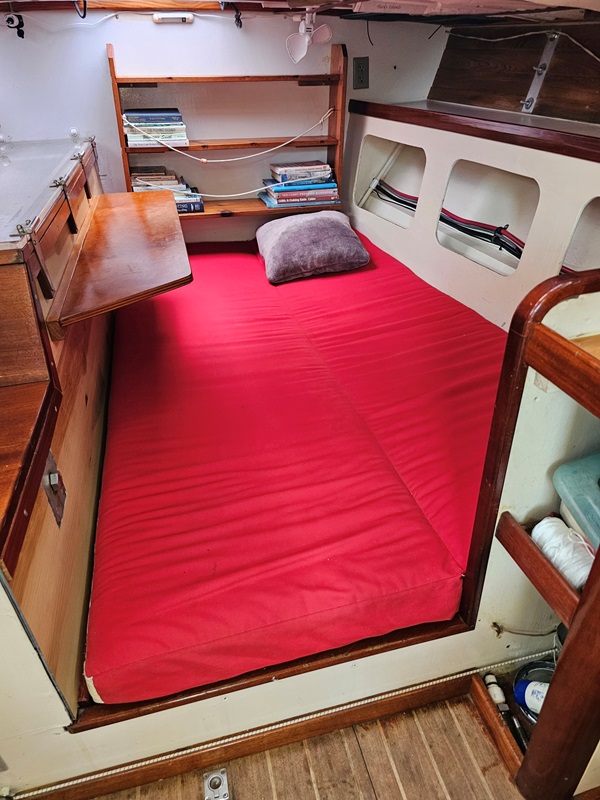
The keel retracts
vertically into a 14”
wide trunk
separating the two berths in the main cabin that extends just
19” above the cushions.
Flip up dining
tables
on the keel trunk are accessible from the adjacent bunks.
Because these bunks are below the dropped foredeck, there is no standing
headroom in that part of the main cabin. Reule called it eating ‘oriental
style’. I prefer ‘Roman lounge style’, but honestly most Americans would call it
uncomfortable style. I believe the benefits outweigh this cost.
Reduced windage and weight above decks
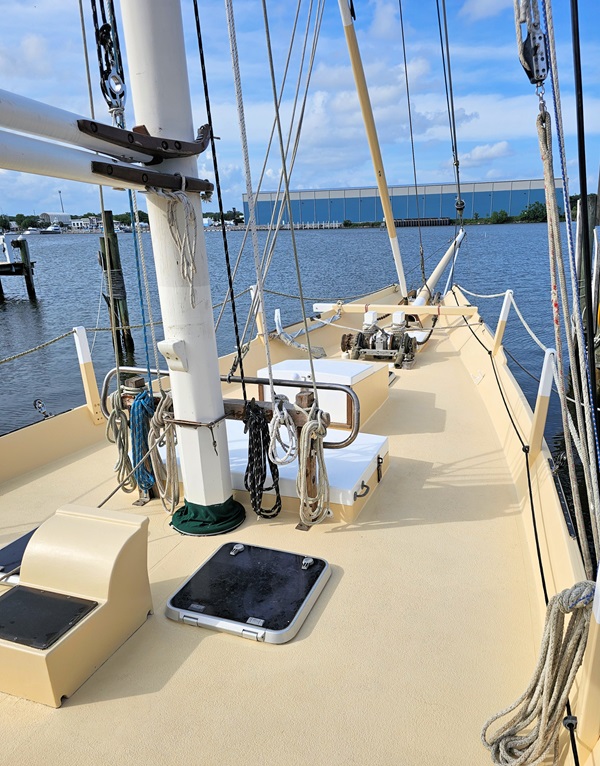
The long, low, “piratical” profile of the boat is not an affectation. It results
from a concerted and effective effort to improve stability and reduce rolling
and heeling from beam winds.
Safety on deck Sails are controlled from the cockpit;
halyards and reefing are managed from the base of the masts. Having a mast
stepped on or through a raised cabin means perching on the roof of the cabin to
raise, reef, lower, furl, or cover the sails. Yes, halyards and reefing lines
can be led through turning and snatch blocks to the cockpit, but this adds
friction and wear. Any snags or twists in the lead still requires a trip to the
mast base. Balancing yourself on the highest platform on the boat, well above
coaming and lifelines while gazing upward and wrestling lines with your free
hand? No problem on a calm sunny
day; big problem offshore in a gale. Both masts on Tien Hou penetrate flush
decks. The foredeck is lowered so it sits near the same level as the cockpit
sole. When working the sails or anchor, you are behind foot-high solid bulwarks
and lifelines 3’ above your feet. For me, the security of being “in
the boat”
instead of “on top of the boat” when it’s rough is worth the
discomfort of sitting cross-legged for meals.
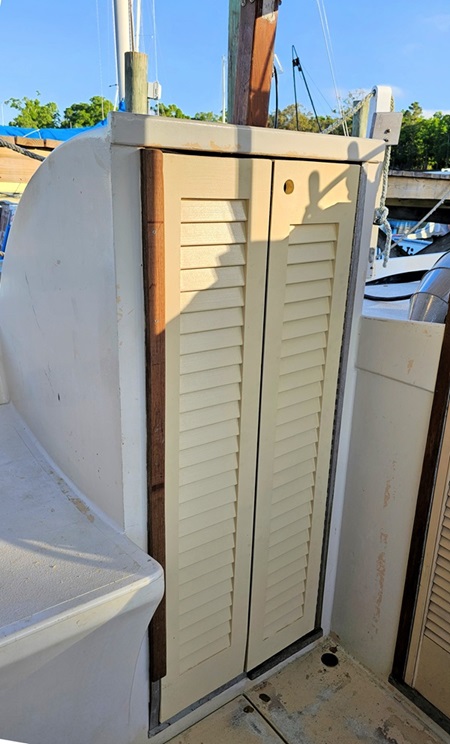
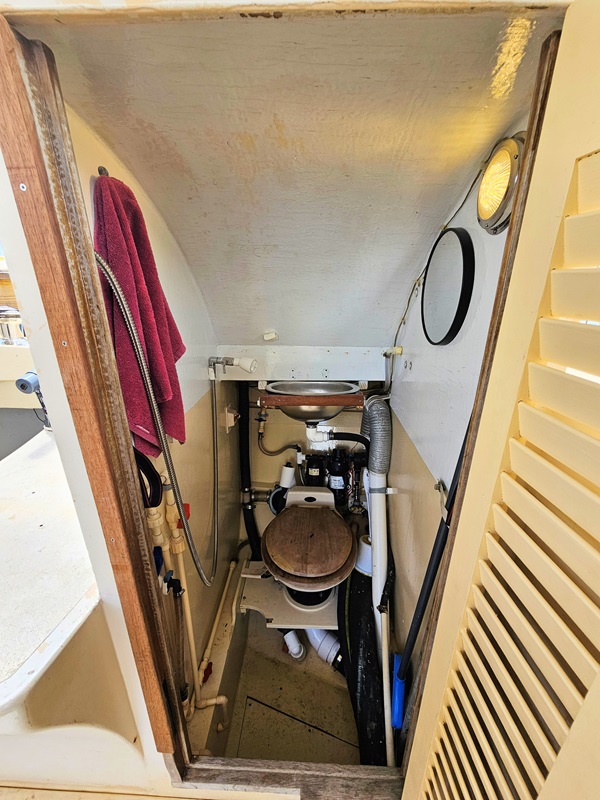
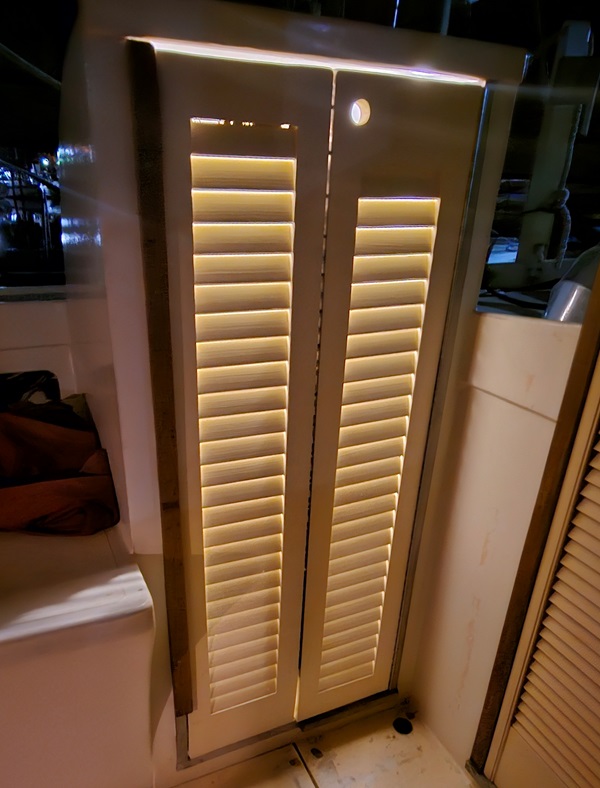
What’s with the head
in the cockpit?
Yes, that’s . . .
different. Discussion:
Pros
·
No smells or noises
in the sleeping, cooking, or eating areas.
Exposure to the sun
and wind
keeps the head compartment airy and dry.
·
The
toilet sits higher than the holding tank
and flushes by gravity through a standard 4” diam. pvc pipe.
No flush pumps or small sewer lines to clean out when they inevitably clog. If a
user still manages to clog a 4’ pipe (!) it can be handled with a plunger.
Flushing water is filled by an electric pump, but in the event of its failure,
the toilet flushes just as well when filled with a bucket of saltwater.
·
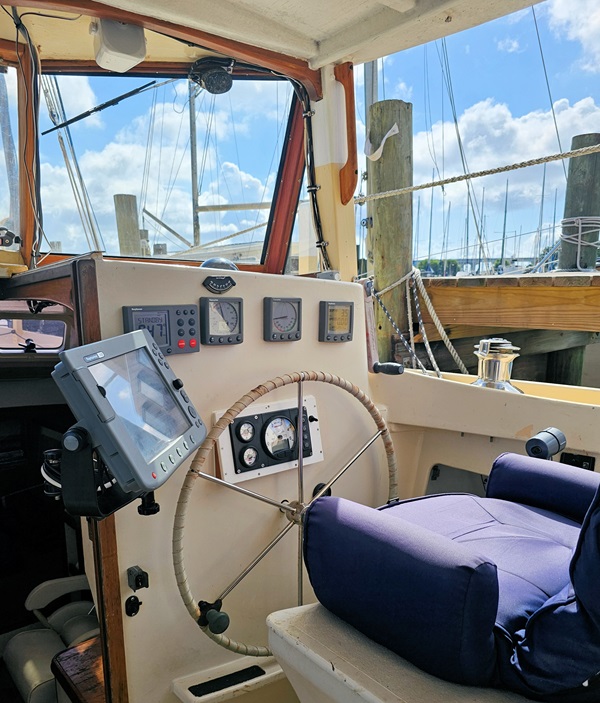
When single handing,
the helm with its
instruments
and 180 degrees of horizon are visible by opening the door
without departing the throne. Could save your life!
Cons
·
It’s in the cockpit.
People adjust.
Enhancements and
upgrades
I don’t particularly
enjoy repairing things, so when I come across a problem I endeavor to fix it in
a way that avoids having to fix it again. If I see anything that I even suspect
may need fixing one day, I try to preemptively upgrade it so I won’t have to fix
it in the future (I’m likely borderline OCD). Some examples follow.
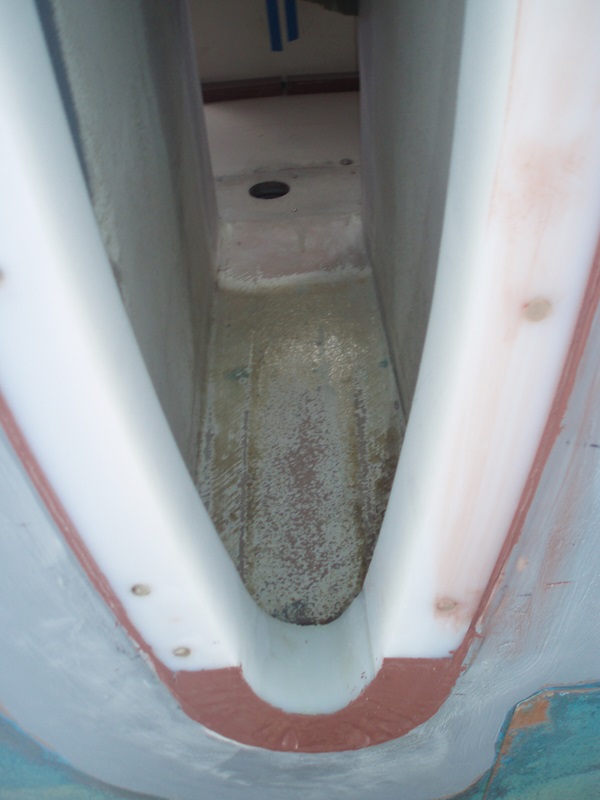
When installing the
keel lifting hardware and the keel, I noticed some wear on the sides of the keel
opening slot. I added strips of high density polyethylene (HDPE) to the inner
sides of the trunk and
encased the keel opening
in 3” HDPE channel as a sliding bearing and cushion surface to
eliminate all play between the keel and hull. I also used HDPE in the form
of split HDPE pipe to make large,
extremely rugged rub
rails
after I damaged the wooden ones while rubbing on an ugly wharf. I no longer fear
even concrete docks.
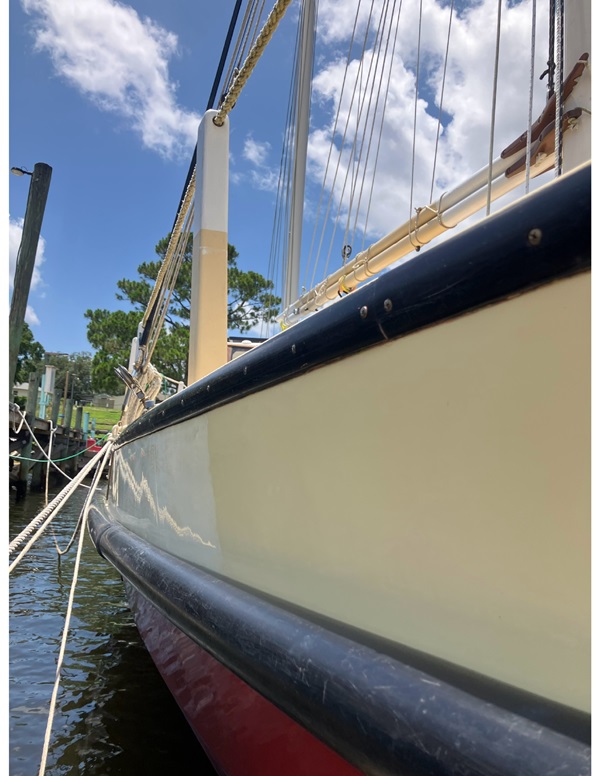
Carbon fiber has
been used in a few select locations to upgrade stiffness and resist wear. The
keel trunk sides have it around the support beams and the locking pin receivers.
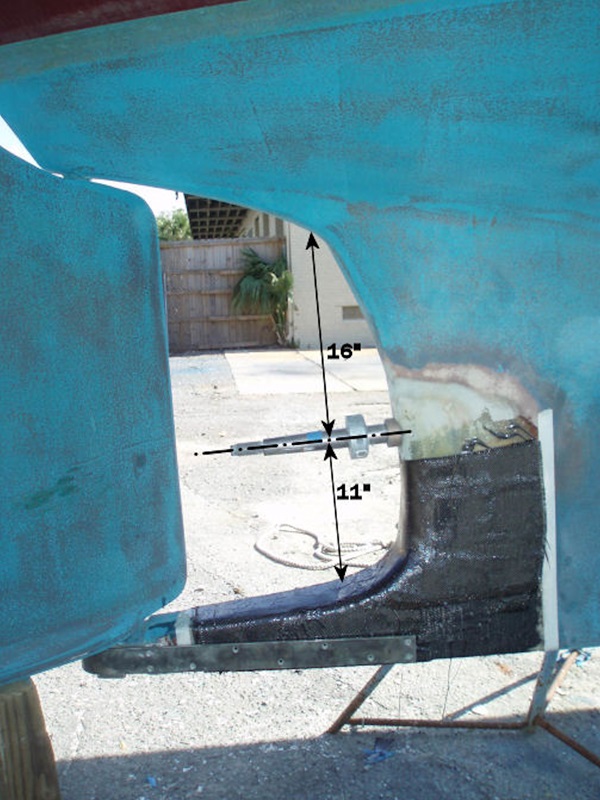
When I calculated a slightly larger but lower pitch prop would be an
improvement (it added nearly a knot to max speed), it necessitated enlarging the
propeller opening by removing some deadwood ahead of the rudder. To compensate
for the loss of material so near the rudder post, I wrapped the
lower skeg
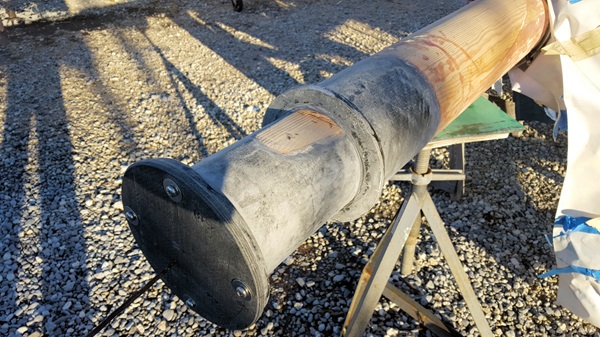
in two layers of carbon woven roving. Likewise, after removing
the masts for painting, I strengthened the mast partner openings with a lining
of carbon roving. More carbon wraps the very
top of the main mast
where the truck (the “crown” the shrouds and stays attach to)
rests.
Sailing
Reule called Tien
Hou the most comfortable boat he’s ever owned. I’ve confirmed that with years of
living aboard. She is also made to
move- a joy to sail. In spite of her size, (which adds a stately,
lower-frequency pace to boat handling) she is easily single handed. Her rigging
utilizes the safe, quick, efficient (and thrifty) methods and gear working
sailors optimized in the 19th century. Things just . . . work.
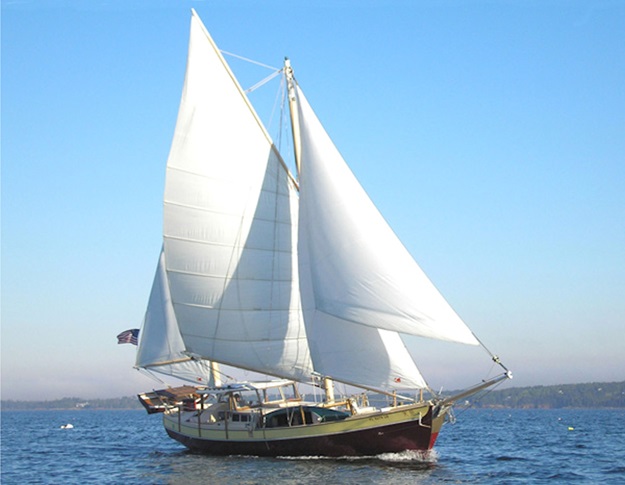
It takes the mizzen
staysail to get much speed under very light air. As winds approach 10 knots, she
steps out; above 20 she gets impressive, and is quite the sled on a broad reach
offshore. With her keel raised she slides down swells like a 50’ surfboard under
perfect control (I’ve hit 15 knots)! Like any gaff rigged vessel, she does not
pinch well on a beat. If I
need to make time to windward, I do what Reule suggested – use the jib and
mizzen as excellent steadying sails and motor sail.
When winds
get much over 20, the flying
jib should be reefed – the large main provides plenty of drive. In higher winds,
the main is easily reefed or lowered because the gaff lays the sail
down quickly and surely between the lazy jacks. In winds over 30 knots,
it’s easier to drop the main altogether than put in a second reef; she’s well
balanced and (because of her light displacement) easily driven under jib and
jigger alone in those conditions.
A Friendly Warning
A new owner will have to get used to something – being noticed. Tien Hou garners attention wherever she goes. Not just from avid sailors – people who have never sailed whip out camera and shout “Beautiful boat!” from shore or passing motorboats. Minor crowds congregate at inlets or marina entrances as she passes. When I anchored in Maine in reclusive The Basin, a local couple rowed out to say “It’s an honnah to have you in our hahbah.” It can get embarrassing, but I can’t argue with them. I felt the same when I first saw her.